
A startup MVP is not just a smaller version of the final product. It is a focused test of whether users care enough to sign up, pay, book, share, message, track, submit or complete whatever action your business depends on. That means the developer you hire should not only know React Native. They should know how to turn a rough idea into a mobile product that can be built, launched and improved without wasting months on the wrong features.
React Native is often a smart choice for MVPs because it allows one development team to build for iOS and Android from a shared codebase. According to the official React Native documentation, React Native lets developers create native apps using React, which makes it attractive when speed, iteration and cross-platform reach matter. For a startup founder, local service business or non-technical operator, that can mean reaching more users without funding two fully separate native builds.
But the hiring decision still needs structure. If you hire React Native app developer talent based only on hourly rate, portfolio screenshots or a confident sales call, you can end up with messy code, unclear ownership, delayed store releases and an MVP that is too bloated to validate anything.
Here is how to hire a React Native developer for a startup MVP with less risk and a much clearer path to launch.
Decide whether React Native fits your MVP before you hire
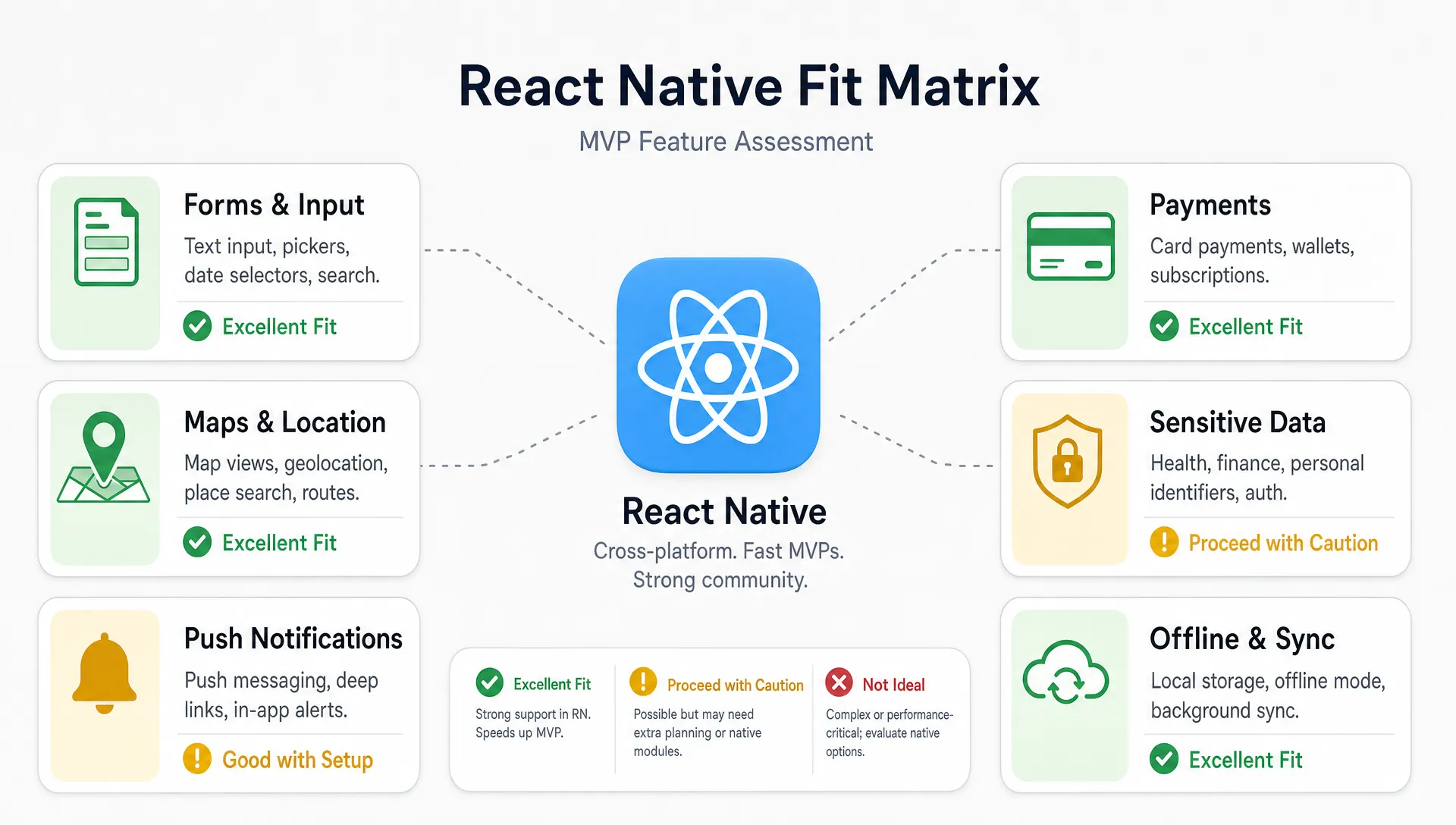
React Native is strongest when your app needs a polished mobile experience on both iOS and Android, but does not depend heavily on complex 3D graphics, advanced native processing or deeply platform-specific behavior from day one.
Common startup MVPs that fit React Native well include booking apps, field service tools, fitness trackers, study companions, lead capture apps, internal operations apps, social prototypes, patient engagement tools and marketplace interfaces. These products usually depend on screens, forms, user accounts, notifications, media uploads, payments, maps or backend APIs. React Native can handle those patterns well when the developer understands mobile architecture.
It may not be the best first choice if your MVP is a high-performance game, an augmented reality product, a camera-heavy editing tool or an app that needs unusually deep integration with device hardware. Those ideas might still be possible in React Native, but the hiring bar is higher because native module experience becomes more important.
| MVP requirement | React Native fit | What to ask a developer |
|---|---|---|
| Launch on iOS and Android quickly | Strong fit | How will you share code while still respecting platform differences? |
| Forms, accounts, dashboards and API-driven screens | Strong fit | How do you structure data fetching, errors and loading states? |
| Push notifications, maps, payments or camera access | Usually a good fit | Which libraries or native modules would you use and why? |
| Heavy animations, games or advanced media editing | Depends on complexity | What performance risks do you see before development starts? |
| Healthcare, finance or sensitive user data | Possible with careful planning | How will you approach privacy, access control and secure storage? |
If you are still comparing technologies, the goal is not to pick the trendiest framework. It is to pick the path that lets you validate the business safely and quickly. For more context on reducing build time across platforms, this guide on how to develop a cross-platform mobile app faster is a useful companion.
Define the MVP outcome before contacting developers
A good React Native developer can help refine scope, but they cannot rescue a vague brief without spending time and money first. Before you start outreach, write down the business outcome your MVP needs to prove.
For example, a lead generation MVP might need to prove that local homeowners will request quotes through a simple mobile flow. A healthcare MVP might need to prove that patients will complete a check-in form before an appointment. A field service MVP might need to prove that technicians can replace paper job sheets with a simple mobile workflow.
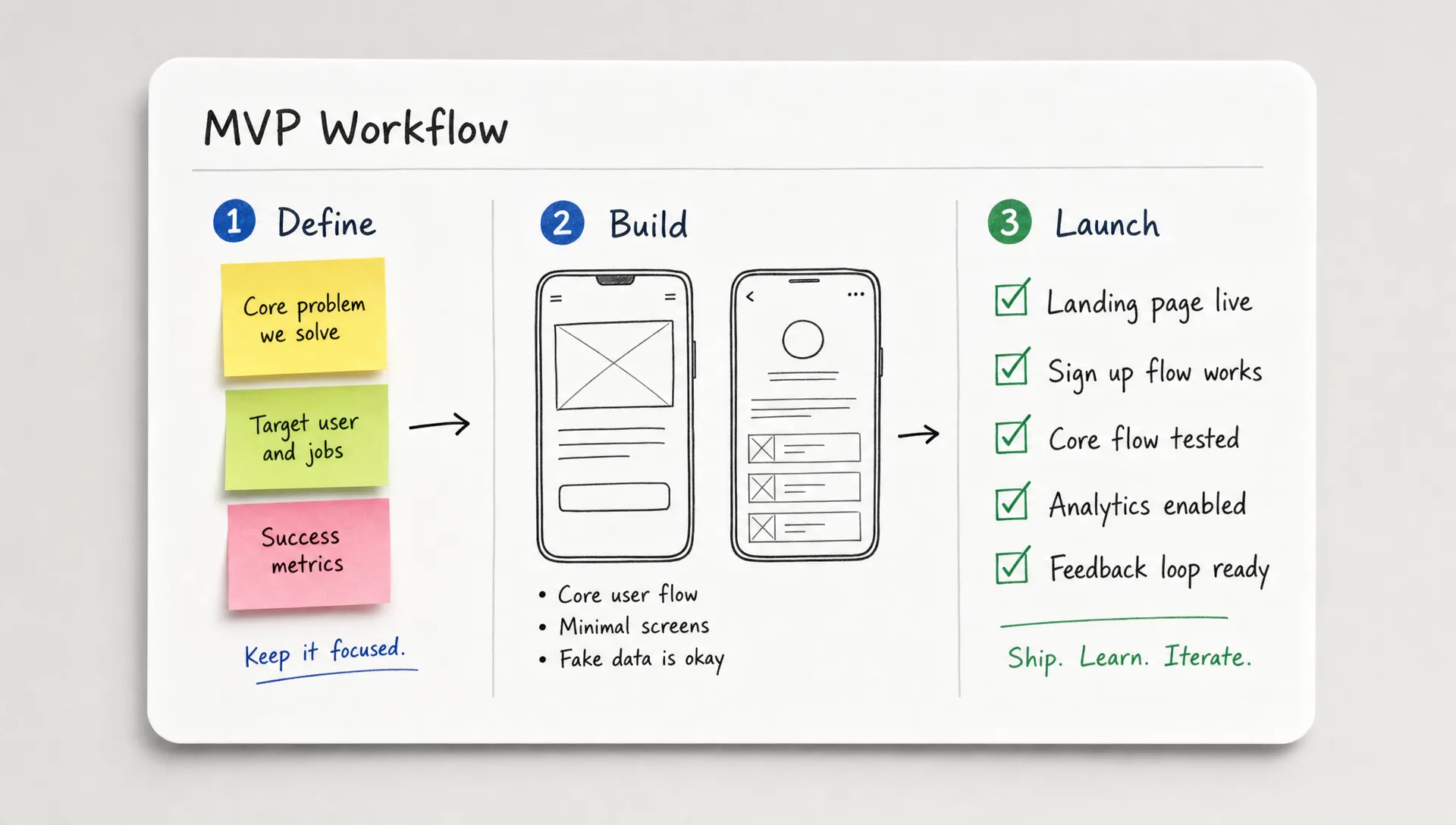
Your first version should have one primary user, one primary workflow and one measurable success signal. If the app tries to serve customers, admins, managers, partners and internal staff in version one, your MVP will likely become a custom software project before you have validated demand.
A developer will give better estimates when you can explain:
- The main user and the problem they have today
- The core action the user must complete in the app
- The screens required to complete that action
- The data that needs to be stored, sent or displayed
- The third-party tools you already use, such as Stripe, Firebase, Supabase, Twilio, HubSpot or a custom API
- Any privacy, compliance or security constraints
If you need help narrowing the product before hiring, start with a practical process to scope an MVP app in 6 simple steps. Scope clarity is one of the biggest differences between a smooth 4-6 week MVP and a build that drifts for months.
Look for startup MVP skills, not just React Native syntax
Many developers can build screens. Fewer can build a mobile MVP that is simple enough to launch, stable enough to test with users and clean enough to keep improving. When hiring for a startup, evaluate the whole skill set.
React Native and TypeScript fundamentals
A strong candidate should be comfortable with React Native components, navigation, platform-specific styling, reusable UI patterns, debugging and performance basics. TypeScript is also a valuable signal because it helps catch mistakes earlier and makes the codebase easier to maintain as the app grows.
Ask how they structure folders, manage shared components and handle differences between iOS and Android. You do not need to understand every technical detail. You are listening for clear thinking rather than vague claims.
API and backend integration experience
Most MVPs are not only mobile screens. They need authentication, database records, server logic, notifications, analytics or integrations with business tools. Even if a separate backend developer is involved, your React Native developer should know how mobile apps communicate with APIs, handle failed requests and protect user sessions.
For non-technical founders, this matters because many MVP failures happen in the gaps between frontend, backend and real user behavior. The app may look finished in a demo but break when users lose signal, enter unexpected data or try to reset a password.
Product judgment and UX thinking
A startup-friendly developer should be able to say no to unnecessary features. If you ask for chat, payments, calendar sync, admin dashboards, AI recommendations and referral rewards in the first build, the right developer should help you prioritize instead of accepting every idea.
Good UX thinking shows up in practical details: clear empty states, readable error messages, fast onboarding, accessible buttons, sensible form validation and fewer steps for the user. These are not luxury items. They directly affect whether early users complete the action you need to measure.
App Store and Google Play release experience
Shipping to the stores is part of the job. Ask whether the developer has handled app signing, TestFlight, Play Console testing, privacy labels, store screenshots and review issues before. Apple publishes its App Review Guidelines and Google maintains Play Console Help for developer policies, but practical experience still helps avoid last-minute surprises.
For an MVP, a release delay can cost you user interviews, investor updates or a planned pilot with a customer. Hire someone who understands the full launch path, not just local development.
Choose the right hiring model for your stage
There is no single best way to hire a React Native developer. The right model depends on your budget, timeline, technical oversight and how much product guidance you need.
| Hiring model | Best for | Main risk |
|---|---|---|
| Freelance React Native developer | Focused MVPs, founder-led products, small business apps | Quality varies, so evaluation matters |
| Small app studio | Broader design and development support | Higher cost and sometimes slower communication |
| In-house developer | Funded startups with long-term product needs | Recruiting takes longer and payroll commitment is higher |
| Offshore team | Larger scope with strict budget pressure | Time zones, handoff quality and accountability can be harder |
| No-code first, developer later | Testing demand before custom build | May hit limits when mobile UX or custom logic matters |
For many early-stage founders, a skilled freelancer or small specialist team is the most practical first step. You get direct communication, faster decisions and less process overhead. The key is to make sure the developer can own more than tickets. They should understand MVP tradeoffs, mobile UX and launch readiness.
If you are evaluating broader mobile hiring options, you may also want to read about how to hire a mobile app developer without costly mistakes.
Use a structured hiring process
A casual call is not enough to choose the person who will build your first product. Use a lightweight but intentional process that tests clarity, communication and delivery thinking.
- Share a short MVP brief: Send a one-page summary with the user, problem, desired outcome, must-have features, nice-to-have features, timeline and any existing designs or tools.
- Ask for similar work: Look for apps with comparable patterns, such as authentication, subscriptions, booking, messaging, maps, dashboards or offline workflows.
- Discuss the implementation plan: Ask how they would break the MVP into milestones, what they would build first and where they see risk.
- Run a paid discovery or prototype phase: For serious projects, a small paid planning phase can validate technical assumptions before the full build starts.
- Agree on ownership and handoff: Confirm that you will own the source code, store accounts, documentation and credentials needed to continue development.
This process does not need to take weeks. A focused founder can often complete it in a few days, but skipping it entirely increases the chance of hiring based on confidence rather than competence.
Ask interview questions that reveal how the developer thinks
The best interview questions are tied to your app, not generic trivia. You do not need to quiz someone on obscure React Native internals. You need to understand how they make tradeoffs, communicate risk and protect the MVP timeline.
| Question | What a strong answer sounds like |
|---|---|
| How would you reduce this idea to a 4-6 week MVP? | They identify the core workflow and suggest postponing non-essential features. |
| What parts of this app are technically risky? | They mention integrations, compliance, offline behavior, performance or store review where relevant. |
| How do you handle API errors and loading states? | They talk about user feedback, retries, validation and edge cases, not just connecting endpoints. |
| How do you keep React Native code maintainable? | They explain component structure, TypeScript, naming, reusable patterns and code review habits. |
| Have you shipped apps to the App Store or Google Play? | They can describe the submission process and common reasons for delay. |
| What would be included in the handoff? | They mention source code, setup instructions, environment variables, store access and documentation. |
| What should not be built in version one? | They show product judgment instead of trying to maximize scope. |
A weak interview often sounds overly agreeable. If every feature is easy, every deadline is possible and no risks are mentioned, that is not reassurance. It may mean the developer has not thought deeply about the product.
Review portfolio work with a founder’s eye
Portfolio screenshots can be misleading because they only show the surface. A beautiful screen does not prove that the app was reliable, maintainable or useful. When reviewing past work, ask what the developer personally built and what constraints they worked under.
For React Native specifically, ask whether the app used one shared codebase for iOS and Android, which libraries were used, how authentication worked and whether the app had real users. If the developer cannot share private client code, that is normal, but they should still be able to explain architecture and tradeoffs without exposing confidential details.
If possible, download live apps they have worked on. Check how fast the app opens, how forms behave, whether buttons feel responsive and how errors are handled. You do not need a technical background to notice friction. If the app feels confusing to you, early users may feel the same way.
Understand budget and timeline drivers
React Native can reduce duplicated iOS and Android work, but it does not make every part of an app cheap or instant. Your budget is still shaped by product complexity, design quality, backend needs, integrations, testing, compliance and post-launch support.
A simple MVP with login, a few core screens, basic data storage and one primary workflow is very different from a marketplace with real-time chat, payments, admin tools, analytics, moderation, notifications and complex roles. Both may be React Native apps, but they are not the same project.
For a 4-6 week MVP, the scope usually needs to be narrow. That might mean launching with email login instead of multiple social sign-ins, one payment flow instead of several plan types, basic admin tools instead of a full dashboard or manual operations behind the scenes while you validate demand.
Be cautious with estimates that are either extremely low or extremely vague. A useful proposal should explain phases, deliverables, assumptions and what is excluded. If the developer cannot explain what happens when requirements change, you may be setting yourself up for conflict later.
Watch for red flags before you sign
React Native hiring mistakes usually show up early if you know what to look for. A low rate is not automatically a red flag, and a high rate is not automatically quality. The warning signs are usually about process and accountability.
- The developer wants to start coding before understanding the user, workflow or business goal.
- They cannot explain what belongs in the MVP and what should wait.
- They avoid discussing code ownership, repository access or handoff.
- They promise identical behavior on iOS and Android without mentioning platform differences.
- They have no clear approach to testing, app store submission or post-launch fixes.
- They rely on too many unmaintained libraries without explaining the tradeoff.
- They communicate poorly during the sales process, which usually gets worse after payment.
If something feels unclear, ask for clarification before work begins. A professional developer will not be offended by clear expectations.
Put the right agreement and handoff terms in place
The contract does not need to be complicated, but it should protect the project. At minimum, confirm ownership, milestones, payment terms, communication rhythm and what happens after launch.
| Agreement item | Why it matters |
|---|---|
| Source code ownership | You need the right to continue development with the same or another developer. |
| Repository access | Your code should live in a GitHub, GitLab or similar repository you can access. |
| Milestones | Clear checkpoints reduce confusion about progress and payment. |
| App store accounts | The business should own the Apple Developer and Google Play accounts when possible. |
| Documentation | Setup notes help future developers run and maintain the app. |
| Post-launch support | Early users will reveal bugs, edge cases and improvements after release. |
| Third-party credentials | Access to services like Firebase, Supabase, Stripe or analytics should be organized and secure. |
This is especially important for non-technical founders. Without a proper handoff, you may own an app in theory but be unable to update it, fix it or transfer it without paying for a rebuild.
Add extra screening for healthcare and sensitive data apps
If your MVP handles patient information, medical workflows, personal data or employee records, do not treat compliance as a plugin you add later. The developer does not need to be your lawyer, but they should understand that sensitive data changes product and technical decisions.
For healthcare software in the United States, review the basics of the HHS HIPAA Security Rule. For apps serving users in the European Union or processing EU personal data, review the principles behind the General Data Protection Regulation. Your exact obligations depend on your business model, partners, data types and legal role.
In practical hiring terms, ask about authentication, role-based access, secure storage, encryption in transit, audit trails, data deletion, consent flows and how third-party services handle regulated data. If the developer dismisses privacy concerns or says everything is compliant without asking detailed questions, keep looking.
Use this final checklist before hiring
Before you make the decision, compare candidates against the things that actually affect MVP success.
| Hiring checkpoint | Green signal |
|---|---|
| MVP understanding | They can explain your core workflow in simple terms. |
| React Native skill | They have built real mobile features beyond static screens. |
| Product judgment | They recommend cutting scope where needed. |
| Communication | They explain tradeoffs clearly without hiding behind jargon. |
| Launch experience | They understand TestFlight, Play Console and store submission basics. |
| Code quality | They mention structure, maintainability, TypeScript and documentation. |
| Ownership | They agree that you own the code and key accounts. |
| Support | They can explain how bugs and improvements are handled after launch. |
A good React Native developer should make your MVP feel more concrete after the first serious conversation. You should leave with a clearer scope, a better sense of risk and a practical launch path.
Ready to build a focused React Native MVP?
Hiring well starts with a clear scope and a developer who understands both mobile execution and startup constraints. If you are ready to build an iOS and Android MVP without turning version one into an oversized product, I am available for mobile app development, cross-platform builds and fast MVP delivery with a clean code focus.
Book a consultation call when you have your core workflow, target user and launch goal ready. A focused first conversation can save weeks of rework later.